
Last Saturday I got fairly drunk, which left my whole Sunday open to walk around mindlessly, recovering from the effects of hangovers. What better place to wander than around my own neighborhood, particularly my local grocery store, searching endlessly, desperately for items I would not know how to use, or make, or anything. I enjoy grocery stores, partially because my favorite poem by Allen Ginsburg is A Supermarket in California, and my favorite song by The Clash is Lost In the Supermarket.

For this particular day, contemplating pop culture, these two pieces seem particularly appropriate. The supermarket, or grocery store (in vernacular terms) is the ultimate source for homogenization. This is where taste typically goes to die. Those old recipes of our grandfathers and grandmothers get lost searching the aisles for something genuine. In his poem, Ginsburg is looking for something real, something genuine. All he can find is images. He finds whole families shopping in the aisles as if the grocery store were a ritual. Here, you find Lorca befuddled, and Whitman completely lost, looking for his angel and only to find pork chops and bananas crudely juxtaposed, side-by-side, in a way they probably would never be in the real world. The poem extends beyond the grocery store, though, and out into the streets, where Ginsburg continues to wander. He is still in search of something genuine, yet the streets, again, leave him just as lonely as the supermarket had, still baraged by images, and nothing with any depth or meaning. In the end, he asks Whitman, whose vision of America in Song of Myself, and America full of ingenuity, freedom, the search for the self only exists within the prim pages of academia, and not within the common people, he asks what has happend to us? Where has the Odyssey gone? Where is the journey? Wh
 ere is the cultural heritage? Where are the stories?
Joe Strummer understands this. His song seems to explain what happens when we are raised in supermarkets. We live empty, meaningless lives without a personality, without interest, an overbearing listlessness and ennui. He explains that life in the supermarket is simply a life of homogeniety, without individuality. A life where you are not born so much as you fall out. The search for identity is over here, because you have no identity to speak of.
"According to MacDonald, mass culture is a threat because it is a homgenous culture which levels down or debases all culture." This is from my pop culture book, "An Introduction to Theoris of Popular Culture." I know, how academic, how perverse. How could I take the easy way out? Yet, I wouldn't know who th
 is MacDonald cat was without helpful textbooks such as this. In this next quote, by MacDonald, try replacing "Mass Culture," with "Supermarket." "[Mass culture] is a dynamic, revolutionary force, breaking down the old barriers of class, tradition, taste, and disolving all cultural distinctness." Simply put, since the industrial revolution, our culture has been produced on a conveyor belt assembly line. Most of the items I own, except my memories, came from slave laborers and sweat shops, and a billion others exactly like it exist. Am I worried, as mass culture theorists are, about the loss of folk culture? Not as much. My fear rests with Ginsburg, that there won't be any culture at all, a complete loss of the self, the journey, that narrative journey that Frederic Jameson is always talking about.
Note the picture above to the left. It exemplifies much about Salt Lake and my own upbringing. I was raised in the Mormon church, a worldwide religion. Salt Lake is the center of that religion (see previous blog). The gatherings on Sunday are huge. In the area I grew up in, there are 4 churches within a 2 mile radius of each other. Each has two wards, and all the wards are still overcrowde
 d, with an attendance of a couple hundred. The religion is uniquely American, and it shows. From America we get the birth of the assembly line, and this is most prevalent within the church. Your progress through the church as well as your life, is strictly guided. If you have the lucky chance of being born into the religion, then you were probably born to parents too young to have children. My parents had their first when my mother was 18, and my father 25ish or so (which makes me wonder what kind of high schools my father was cruising). You go through being a sunbeam, and primary school, until you turn 8, and then you are baptized (which is a fairly noble aspect of the church. Rather than being baptized at birth and not having a choice, you get to mature to the ripe age of 8 to make the decision of faith. Another uniquely American aspect, stemming from the Great Awakening). You move on through the religion. If you are a girl, your progress pretty much ends there. You are best off learning how to knit in a group known as "Relief Society." If you are a boy, you contine, becoming a Deacon, then a Priest, then an Elder. I made it as far as Priest, which is pretty okay when compared to other religions, how it takes years of religious training and study and seminary to reach the level of priest. All I had to do was turn 13. When you turn 21 you go on a mission, and when you return 2 years later you get married and have kids w
 hen you are probably far too young to have kids. This is the standard, and, as you can see, very conveyor-belt style. Did I mention how exciting church is? Just look at the expressions of the Mormon congregation above. Absolutely enthralled. I think you may see the effects of homogenization written all over their faces.
But why does it begin at the supermarket? Why do Ginsberg and Strummer see the supermarket as the death of the metanarrative. It has something to do with how identical everything is. Perhaps it is the end of the great "family recipe" as I mentioned above. I think a better example might have to do with some kind of Maslow's hierarchy. Food is the most basic and essential element of human life. If you can't eat you can't live and and wake up and have a bunch of friends and get drunk and do drugs and go to sweet rave parties. We need food. If only someone had a handle, a control of food. Why, tha
 t person would be a genius! So, all of this food is put in one place. The pork chops are next to the bananas and all of that. The more food this place has, the more desirable it would be to go to this place, rather than the alternative hunting and gathering. Thus, this place exists, the market, where all the food is. Of course, there are several different companies making the same food, so there are different containers of the same food. But if there is so much of the same thing, it would probably help to make the product stand out. BAM, marketing, images. Of course, all of it tastes the same, the only real difference is the images. So, lots of people come to this place, and it has to grow to become a supermarket. It catches on. The whole town comes to this place. I am not a statistician, but I believe more people will go to the supermarket than to chu rch, or to school, or to any place that offers something close to the top of Maslow's hierarchy, that whole "self-act ualization" business. So, this pl
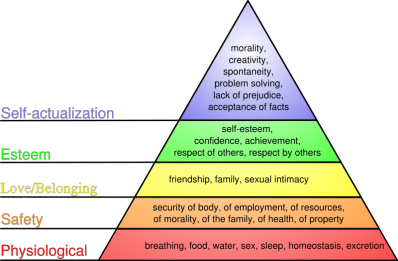 ace becomes the center of everything you need. This place needs to make money, so th e re is more and more marketing. Eventually, this place offers everything you need that apprears on the botton of the heirarchy, which you might remember from high-school-debate days, is breathing, food, water, sex, sleep, etc. It is the nerve center. But that is all it has. And there is a lot of importance placed on that low tier of the heirarchy, because there isn't as much money to be made on the other things. So, these items are marketed to be the most important items of life, which are homogenous. Thus, the life of the society become homogenous.
If I am not careful, I might become a mass culturist.


No comments:
Post a Comment